Classes
This section shows the different classes used in AERzip. Currently, there is only one class which is used to handle the compressed file header.
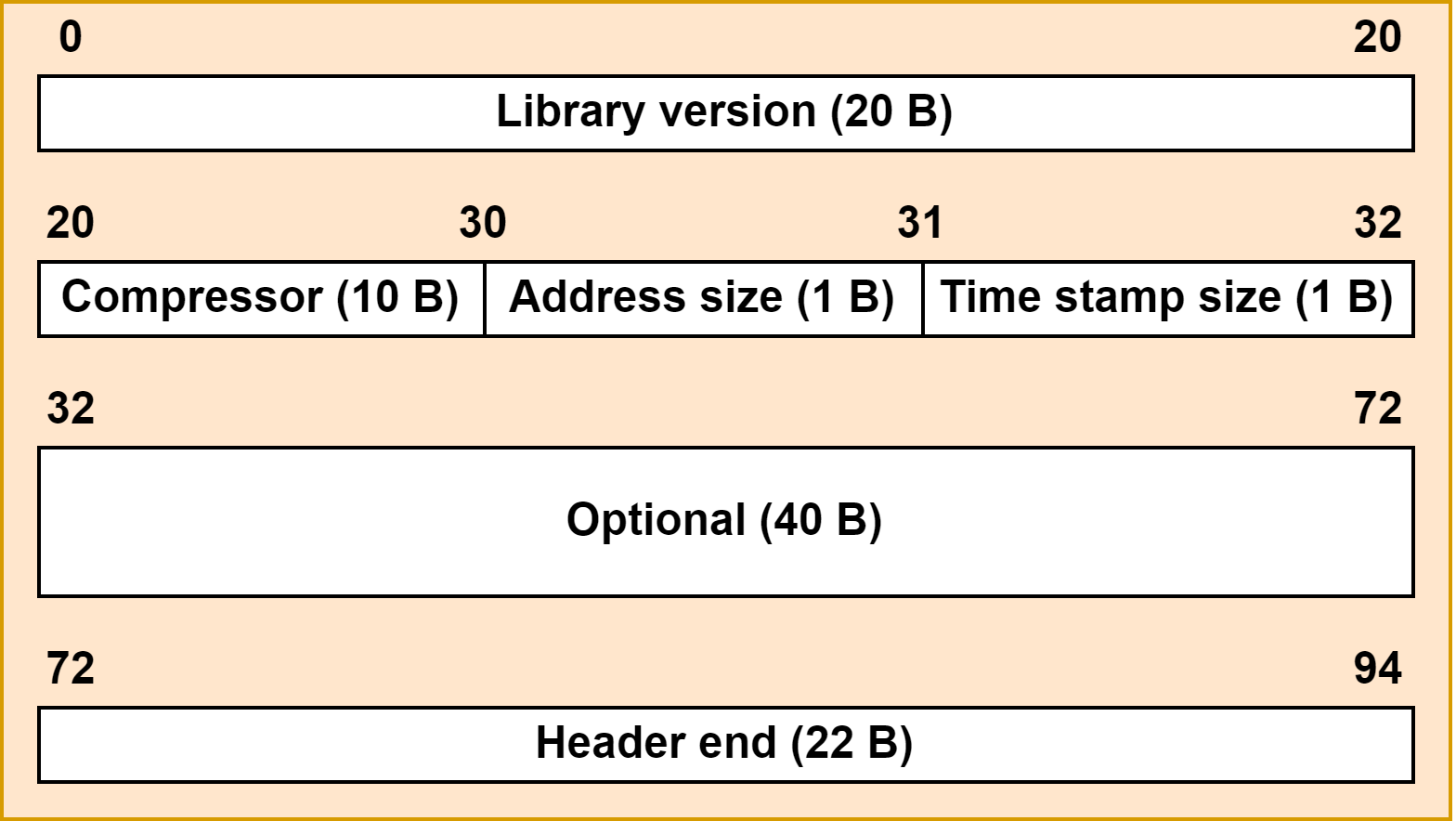
- class AERzip.CompressedFileHeader.CompressedFileHeader(compressor=None, address_size=None, timestamp_size=None)[source]
Bases:
objectA CompressedFileHeader contains useful metadata for compressed files from AERzip. Thus, compressed files consist of a header and the recorded data (addresses and time stamps of the spikes).
The main fields of this header are the following:
library_version (string): A string indicating the library version.
compressor (string): A string indicating the compressor used.
address_size (int): An integer indicating the size of the addresses contained in the compressed file.
timestamp_size (int): An integer indicating the size of the timestamps contained in the compressed file.
header_end (string): The string that represents the end of the header. This is the string used in generic AEDAT files.
Each field has a specific size. Thus, the sum of the size of all these fields determines the total size of the header.
- addOptional(data)[source]
This function allows to insert data (in bytes) into the optional field of the header.
- Parameters:
data (bytearray) – Data to insert into the optional
- Raises:
MemoryError – It is not allowed to use this function when there is not enough space in the optional field.
- Returns:
None